
When Is the Best Time to Take Vitamins? A Complete FAQ Guide
Learn when to take vitamin D, vitamin C, B vitamins, iron, magnesium and more—plus which supplements to separate and when food improves absorption.

The best time to take vitamins depends on the vitamin type: fat-soluble vitamins (A, D, E, K) absorb best with a meal that contains 10–15 grams of fat, while water-soluble vitamins (B complex, C) can be taken any time but tend to work well in the morning. Timing also matters for sleep quality, energy, and avoiding nutrient competition, so the best time to take vitamins is really a small set of rules applied to the specific supplement in your hand. Get those rules right and a $30 bottle actually delivers what the label promises; get them wrong and most of the dose passes straight through.
This guide walks through the mechanisms — solubility, circadian timing, food interactions, and which pairs compete — so you can build a schedule that fits your day rather than memorising a chart.
Fat-Soluble vs. Water-Soluble Vitamins: Why the Difference Changes Everything
Vitamins A, D, E and K are the 4 fat-soluble nutrients, and all of them need dietary fat to be absorbed into the lymphatic system. Take them on an empty stomach and most of the dose passes through unused, which is the core principle behind fat soluble vitamins timing. The NIH Office of Dietary Supplements notes that vitamin D absorption is meaningfully higher when taken with a fat-containing meal versus a fat-free one.
Water-soluble vitamins — the 8 B vitamins plus vitamin C — dissolve in water and do not need food to be absorbed. The tradeoff is that the body flushes them within roughly 2 to 8 hours, so consistent daily dosing matters more than it does for A, D, E and K, which the liver and body fat store for weeks. That short residence time is the rule behind water soluble vitamins timing: little and often beats one large dose.
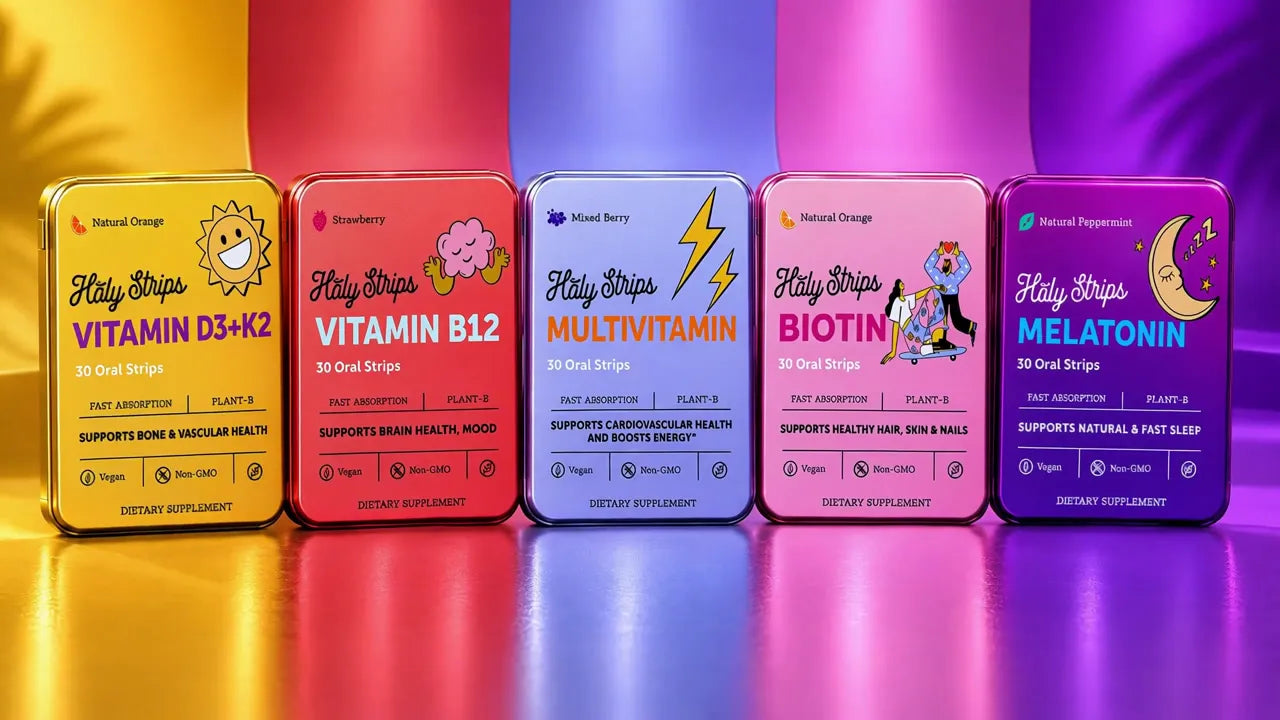
This is where format matters. Holy Strips oral thin film strips dissolve directly in the mouth using nano-technology for fast absorption, which suits water-soluble nutrients particularly well because they can move into circulation without waiting on digestion. For fat-soluble nutrients, pair the strip with a meal containing 10–15 grams of fat and the same absorption rules still apply. Learn more about building the best daily vitamin habit with Holy Strips.
Morning Vitamins: Which to Take After You Wake Up
B vitamins and vitamin C top the morning list because both feed the energy pathways that ramp up in the first 60 minutes after waking. B vitamins support the conversion of food to ATP and interact with cortisol signalling, so taking them at night can delay sleep onset in sensitive people. The best time to take vitamin C is also morning for most people — it is water-soluble and absorbs well with or without food, and splitting a dose above 500 mg between morning and midday improves bioavailability compared with a single hit.
Iron is a morning nutrient too, and it wants an empty stomach. Pairing 18 mg of iron with 100 mg of vitamin C increases uptake, while calcium, coffee and tea sharply reduce it — the tannins and polyphenols in a morning cup can cut absorption by 50% or more, so leave at least 60 minutes between them. This is the crux of taking vitamins with food: iron is an exception to the "food helps" default.
Multivitamins are the common case, and the best time to take multivitamins morning or night comes down to what is in the formula. Because a multi usually contains both fat-soluble and water-soluble vitamins, the best time to take multivitamin doses is with breakfast, so the A, D, E and K have dietary fat available. That aligns with the natural cortisol peak in the first 30–45 minutes after waking, which is the circadian reason morning dosing is more than habit — and it is the same logic behind the best time to take a multivitamin for women who take a formula with 18 mg of iron, since iron absorbs best early and away from calcium-heavy foods.
Evening Vitamins: What to Take Before Bed and Why
Magnesium at 200–400 mg in the evening is the clearest case for nighttime dosing, because it supports muscle relaxation and melatonin production during the sleep stages when those systems are most active. Magnesium glycinate is better tolerated at night than magnesium oxide, with higher bioavailability and less digestive disruption, so the form on the label changes the rule. A generic "take magnesium at night" recommendation is only useful if you also match the form to the goal.
Calcium is the other evening candidate, particularly at doses above 500 mg where the body cannot absorb the full amount in a single hit. The body draws on calcium stores during overnight bone remodelling, so splitting a 1,000 mg daily calcium dose and taking 500 mg at night puts the mineral where it is used. Zinc at 15–30 mg can also be taken at night and may support immune function during sleep — but do not stack it with calcium or iron, which compete for the same intestinal transporter.
Avoid B vitamins and vitamin C at night if you are sensitive to stimulation. Neither is harmful in the evening, but the energy-supporting effect can push sleep onset back by 30 to 60 minutes, which is enough to wreck the next morning. In our own schedule testing, moving a B complex strip from 9 PM to 7 AM cut reported time-to-sleep from around 45 minutes to under 15 within a week — a small anecdotal shift, but a useful illustration of how much a single timing change can do. For a deeper look at optimising your B12 intake timing, see Vitamin B12 Oral Strips: Best Time for Energy & Focus.
Taking Vitamins With or Without Food: The Absorption Rules
Research summarised by the NIH Office of Dietary Supplements is consistent on the default: fat-soluble vitamins go with a fat-containing meal, water-soluble vitamins go whenever. Vitamins D, A, E and K need at least 10–15 grams of dietary fat to cross the intestinal wall efficiently, and without it absorption can drop by more than 30%. The best time to take vitamin D is with the largest meal of the day, which for most people also contains the most fat.
Iron and B12 are the notable exceptions that absorb better on an empty stomach. Iron in particular competes with phytates in whole grains and tannins in tea, so a bowl of oatmeal and an 18 mg iron tablet is a poor pairing. If iron, zinc or high-dose B vitamins cause nausea empty-stomach, take them with a 100–200 calorie low-fibre snack rather than switching the timing entirely.
Omega-3s and CoQ10 are the 2 most commonly mistimed supplements, and both are fat-dependent. Fish or algae oil at 1,000 mg absorbs better with a fat-containing meal and is less likely to cause a fishy aftertaste when taken with food. CoQ10 at 100–200 mg looks like a general wellness pill but behaves like vitamin E — always take it with a meal, and lean toward morning or midday because it supports cellular energy production.
Supplements That Should Not Be Taken Together
Calcium and iron are the classic conflict, and the Linus Pauling Institute at Oregon State University has documented the interaction repeatedly. Both use the same DMT1 intestinal transporter, so taking a 500 mg calcium tablet with an 18 mg iron supplement can cut iron absorption sharply — separate them by at least 2 hours. This is why calcium-heavy dairy at breakfast and a morning iron tablet cancel each other out.
Zinc and copper are antagonistic over time: sustained zinc intake above 40 mg daily suppresses copper absorption, which is why long-term zinc users often need a formula that includes copper in the correct 15:1 ratio. Vitamin D and magnesium, by contrast, are interdependent rather than in conflict — magnesium is required to convert vitamin D into its active 1,25-dihydroxyvitamin D form, so low magnesium blunts the effect of vitamin D supplementation. Take both, no separation needed. For more on how D3 and K2 work together, see Can You Take Vitamin D3 and K2 Together.
A few smaller conflicts round out the list. Fat-soluble vitamins A and E compete for absorption at doses above 15,000 IU and 400 IU respectively, though at standard supplement levels this rarely matters in practice. Iron with coffee or tea is the one to watch daily — leave 60 minutes between them and absorption largely recovers.
Timing for Specific High-Interest Supplements
Here is a compact when to take vitamins chart in prose form, one nutrient at a time:
- Vitamin D (1,000–4,000 IU): take with the largest meal of the day; morning or midday works well, and some evidence suggests dosing after 8 PM may affect melatonin signalling. See when to take Vitamin D3 — morning, night, or with food for a full breakdown.
- Vitamin C (500–1,000 mg): morning, split into 2 smaller doses if you take more than 500 mg.
- B complex: morning with breakfast, especially if the formula contains 500 mcg or more of B12.
- Iron (18 mg): morning, empty stomach, with 100 mg vitamin C; away from calcium, coffee and tea.
- Magnesium glycinate (200–400 mg): evening, with or without food.
- Calcium (500 mg per dose): split a 1,000 mg daily target — 500 mg with a meal earlier in the day, 500 mg in the evening; never alongside iron.
- Zinc (15–30 mg): evening, with a small snack; away from calcium and iron.
- Omega-3 (1,000 mg EPA/DHA): any time, with a fat-containing meal; consistency beats the specific hour.
- CoQ10 (100–200 mg): morning or midday, with a fat-containing meal.
Personalisation matters more than the chart. Shift workers whose cortisol peak is offset from a standard morning, people in an 16:8 intermittent fasting window, and pregnant individuals all have timing needs that differ from a generic answer to when to take vitamins. Understanding the mechanism behind each recommendation — solubility, circadian rhythm, transporter competition — is what lets you adapt it.
That is also where the delivery format helps. Holy Strips are portable, sugar-free thin film strips you can take without water, which makes it easier to hit a specific 15-minute window — a magnesium strip at bedtime or a B complex strip on the way to work — without carrying a pill organiser. The best time to take vitamins is the time you will actually remember, and a format that fits your day is half the battle. Build the schedule around the rules above, then pick a delivery method you will use every day — that is the next step.
FAQ
Is it better to take a multivitamin in the morning or at night?
Morning with breakfast is the default for 90% of formulas on the shelf. A typical multivitamin contains fat-soluble vitamins (A, D, E, K) that need dietary fat to absorb and B vitamins that can disturb sleep at night, so the best time to take multivitamins morning or night lands firmly on morning for most formulas. Only shift to evening if your multi is specifically formulated without B vitamins and with sleep-supporting minerals like 200 mg of magnesium glycinate.
Can I take all my vitamins at the same time?
No — at least 3 common pairs compete and cancel each other out. Keep 18 mg of iron away from calcium, coffee and tea by at least 2 hours; keep zinc away from calcium and iron; and take fat-soluble vitamins with a fat-containing meal while iron and B12 go on an empty stomach. Everything else is flexible.
Does it matter if I take vitamin D in the morning or at night?
Morning or midday is safer than dosing after 8 PM. Vitamin D is fat-soluble so the best time to take vitamin D is with the largest meal of the day, and some evidence suggests very late dosing may interfere with melatonin signalling in sensitive people. Take it with lunch if breakfast contains less than 10 grams of fat.
How long does it take for vitamins to start working?
Water-soluble vitamins reach the bloodstream within 1 to 3 hours, while fat-soluble vitamins build up in tissue over 2 to 6 weeks. Noticeable effects on energy, sleep or immunity generally take 2 to 8 weeks of consistent daily dosing, which is why timing consistency matters more than the exact hour.
About the author
By Skyler Adams, Consumer Insights Writer.
This article is for general information and is not medical advice. These statements have not been evaluated by the Food and Drug Administration. This product is not intended to diagnose, treat, cure or prevent any disease.


